

Your client asked for SEO. You said yes. Now you need someone to actually do it.
For most marketing, web design and PPC agencies, hiring a full in-house SEO team doesn’t make sense until there’s steady volume. That’s why white label SEO has become the default way to add the service: a specialist team does the work, and you deliver it under your own brand.
The model is simple. Picking the right partner is not. The wrong one can cost you a client, your margin, or your reputation, sometimes all three. This guide gives you the nine questions that separate a reliable partner from a risky one.
Quick answer: how do you choose a white label SEO partner?
Choose a white label SEO partner by checking five things: the people who will actually do the work, how they build links, what reporting you receive under your brand, how they communicate and handle deadlines, and what the contract says about confidentiality, client ownership and cancellation. Then start with one pilot client for 60 to 90 days before you move your whole roster.
White label vs. in-house vs. freelancers: what’s actually different?
Before you compare providers, be clear about what you’re comparing them to. Each option trades cost, control and speed differently.
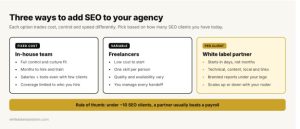
Three ways to add SEO to your agency
| In-house team | Freelancers | White label partner | |
| Upfront cost | Salaries, tools, training | Low | Low (monthly per client) |
| Time to start | Months (hiring) | Days to weeks | Days |
| Coverage | Limited to who you hire | One skill per person | Technical, content, local, links |
| Brand control | Full | Varies | Full, if reports are branded |
| Biggest risk | Fixed cost with few clients | Inconsistency, availability | Choosing the wrong partner |
If you sell SEO to fewer than eight or ten clients, a partner usually beats a payroll. As volume grows, many agencies keep the partner and hire one in-house strategist to own the client relationship.
The 9 questions to ask before you sign
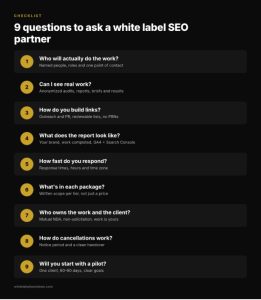
9 questions to ask a white label SEO partner
1. Who will actually do the work?
Many “providers” are resellers of resellers. Ask for the names, roles and experience of the people who will touch your clients’ sites. You want to know:
- Who audits and fixes technical issues. This person should be comfortable with crawls, Search Console, redirects and structured data.
- Who writes the content. Native or near-native English, with experience in your clients’ industries.
- Who your point of contact is. One named person, not a ticket queue.
If they can’t tell you who’s doing the work, assume it’s being passed down the line.
2. Can I see real work, not just a sales deck?
Ask for anonymized samples: an audit, a monthly report, a content brief, a published article and a before-and-after from a real project. Good partners keep client names confidential, so redacted samples are normal. A complete lack of samples is not.
3. How do you build links?
This is the question that protects your clients the most. Google’s spam policies are clear that buying or selling links to manipulate rankings is link spam. Ask:
- Where do links come from? Outreach, digital PR, guest articles on real sites, local citations?
- Can I review every link before it goes live, or at least see the full list monthly?
- Do you use private blog networks or paid link packages? (The only acceptable answer is no.)
A partner who promises “50 DA70+ links a month” for a low fixed price is selling risk, not SEO.
4. What does the report look like under my brand?
You’ll send these reports to your clients, so they need to be clear, branded and honest. Look for:
- Your logo, colors and domain, with no mention of the partner.
- Work completed that month, not just charts.
- Rankings, organic traffic and conversions from GA4 and Search Console.
- Plain-language next steps your account manager can explain on a call.
5. How fast do you respond, and in what time zone?
Clients don’t care that your partner is busy. Ask about response times, working hours and how urgent issues (a site going down, a deindexed page) are handled. Partners in a similar time zone are a big advantage: a nearshore team in Latin America, for example, works the same business day as U.S. agencies, so problems get fixed today, not tomorrow.
6. What’s included in each package?
“SEO” can mean a monthly ranking report or a full program. Get a written scope for each tier: hours or deliverables, number of pages optimized, content pieces, link building, technical fixes and local SEO. If two providers quote very different prices, the scope usually explains why.
7. Who owns the work and the client?
Your contract should state that:
- All work becomes yours (and your client’s) once paid.
- The partner will never contact or solicit your clients directly.
- Both sides sign a mutual NDA.
- Logins and assets stay in your client’s accounts, not the partner’s.
8. How do you handle cancellations and handover?
Clients leave. Partners change. Ask for the notice period, what happens to work in progress, and whether you get a clean handover: audit files, keyword maps, content and link lists. A 30-day notice is common and fair.
9. Will you start with a pilot?
The best way to evaluate a partner is to watch them work. Start with one client for 60 to 90 days. Set three or four clear goals at the start, such as technical fixes completed, pages published and reporting quality, and review them at the end.
Score every provider the same way
When you’re talking to three or four partners, it’s easy to pick the one with the best sales call. A simple scoring sheet keeps the decision honest.
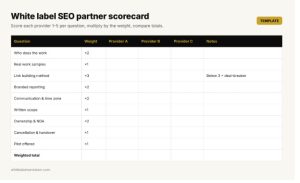
White label SEO partner scorecard template
Rate each provider from 1 to 5 on the nine questions, weight the ones that matter most to your agency (link building and communication usually top the list), and compare totals. Anything below a 3 on link building is a deal-breaker, no matter the price.
Red flags that should end the conversation
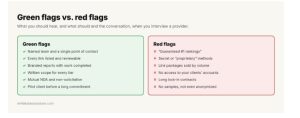
Green flags vs. red flags when choosing a white label SEO provider
- Guaranteed rankings. Nobody controls Google. Google itself warns site owners about SEOs who guarantee a #1 ranking in its guide on hiring an SEO.
- Secret methods. If they can’t explain what they do, they shouldn’t be doing it on your clients’ sites.
- Link packages sold by volume. Quality links take outreach and time.
- No access to accounts. You should always be able to see Search Console, GA4 and Google Business Profile.
- Long lock-in contracts. A good partner keeps you with results, not penalties.
When it makes sense to bring in a partner
If you’re turning down SEO requests, delivering SEO late, or watching margins disappear into freelancer management, it’s time. A dedicated white label SEO agency can take on technical SEO, content, local SEO and link building under your brand, so you sell the service and keep the client relationship without adding payroll.
Whichever partner you choose, use the nine questions above, start with a pilot, and judge them on the work, not the pitch.
FAQ
What is a white label SEO partner?
A white label SEO partner is a company that does SEO work for your agency’s clients, which you deliver and bill under your own brand. Your clients deal only with you.
How much does white label SEO cost?
It depends on scope. Monthly retainers per client commonly range from several hundred to a few thousand dollars, depending on technical work, content volume and link building. Always compare written scopes, not just prices.
Will my clients know I use a white label provider?
Not if the partner works under your brand: branded reports, no direct contact with your clients and a signed NDA. Many agencies still choose to be open about having a specialist team behind them.
Is white label SEO safe for my clients?
Yes, if the partner follows Google’s guidelines, explains every tactic and lets you review links. Most of the risk comes from cheap link packages and guaranteed-ranking offers.
About the author
Juan José Giraldo is a senior SEO, GEO and AEO specialist based in Medellín, Colombia. He works on technical and local SEO for 600+ U.S. car dealerships, supervises SEO for 18 U.S. e-commerce stores, and runs White Label SEO LATAM, a nearshore white label SEO partner for marketing agencies.